
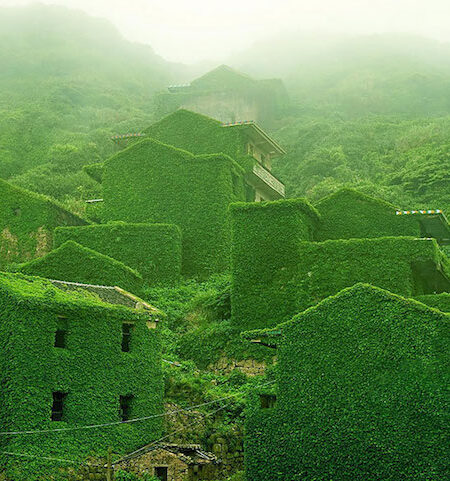
Time has a way of erasing what we leave behind, and nowhere is that more hauntingly evident than in the forgotten buildings slowly being reclaimed by the earth. Once thriving homes, factories, and places of worship now stand in eerie silence, their walls crumbling under creeping vines, shifting soil, and relentless decay. Some were abandoned after disasters, others left to rot due to changing economies or forgotten histories, but all share a common fate—nature is taking them back. As trees burst through rooftops and roots strangle brick and stone, these structures become eerie reminders of how fleeting human creation can be. Whether swallowed by forests, buried in sand, or sinking into swamps, these lost places tell a story of time’s unstoppable march.
Marco Island

Off the coast of Marco Island, Florida, the Cape Romano dome homes are relics of a futuristic dream that nature has since reclaimed. Built in the early 1980s by oil executive Bob Lee, these eco-friendly dome structures are self-sustaining vacation homes (if you squint). However, Florida’s relentless weather and rising sea levels have eroded these visions of modern living. Now, the domes are slowly sinking into the Gulf of Mexico, their faded white walls a ghostly reminder of what might have been.
The Yonaguni Monument
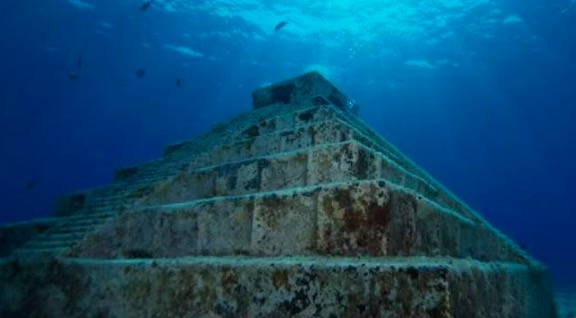
Off the coast of the Japanese island of Yonaguni lies a geological marvel that has sparked debate and fascination among scientists and historians alike—the Yonaguni Monument. Discovered in the late 20th century, this underwater structure comprises massive stone formations, some reaching heights of over 25 meters, arranged in a complex and seemingly deliberate manner. The monument’s unique features, including terraces, steps, and what appear to be carved pillars, have led some researchers to propose that it is a man-made artifact, perhaps dating back to a lost civilization from thousands of years ago. However, others argue that the formation is a natural geological phenomenon, shaped over millions of years by the forces of wind and water. Despite ongoing research and exploration, the origins and purpose of the Yonaguni Monument remain hotly contested, leaving it as one of Japan’s most enduring mysteries and a tantalizing reminder of the mysteries that lie beneath the ocean’s surface.
Gonjiam Psychiatric Hospital, South Korea
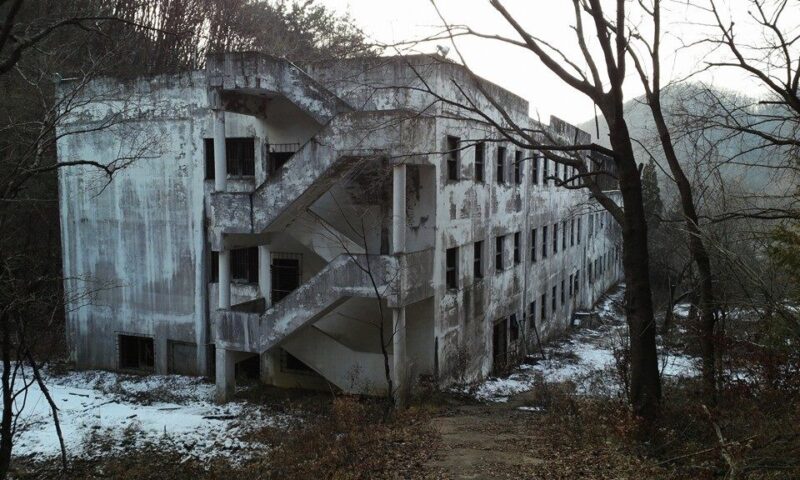
In the quiet aftermath of its demise in May 2018, Gonjiam Psychiatric Hospital lingers as a spectral figure in South Korea’s haunted history, its eerie tale etched into the fabric of its enigmatic past. This building, built in the 1970s, was a psychiatric hospital and a repository of tragic and mysterious stories. Things got dark in the 1990s when a sewage system disagreement occurred. The owner and director clashed on whether to upgrade, leading to the hospital’s closure. As whispers of the director’s demise and the owner’s escape to America swirled, Gonjiam Psychiatric Hospital transformed into the stuff of local legends, an unsettling enigma in the landscape. After the building’s closure, the shattered windows and decaying walls became nature’s way of saying, “I’m taking over now.” Mother Nature decided to turn the place into her avant-garde art project, complete with vines, weeds, and a touch of existential despair. Vandals played the role of intrusive spirits, breaking windows and scattering shards across the lifeless floors.
Holland Island, Maryland

Holland Island, Maryland, tells the story of a once-thriving community that succumbed to the relentless forces of nature. The island was home to a bustling population of fishermen and farmers, but the encroaching Chesapeake Bay slowly eroded the land, forcing residents to abandon their homes. Today, the island’s last remaining house has collapsed, and the once-lively settlement is now a haunting reminder of the unstoppable power of the sea.
The Hachijo Royal Hotel

The Hachijo Royal Hotel on Japan’s Hachijojima Island was once a popular honeymoon destination, known as the “Hawaii of Japan.” Built in the early 1960s, the hotel offered guests luxurious accommodations and stunning views of the island’s volcanic landscape. But as Japan’s tourism market evolved, the hotel fell out of favor and was eventually abandoned in 2006.